The best read-it-later apps in 2026 (and the flaw most of them share)
A fair roundup of the best read-it-later apps in 2026: Instapaper, Readwise Reader, Raindrop, Matter, GoodLinks, Cubox, Karakeep, and Wallabag, with current pricing, trade-offs, and the one limitation to watch for.
You save articles all day, then never read them, then can't find the one you actually wanted. With Pocket gone, the obvious question is which read-it-later app to use now. The short answer depends on whether you want the best reading experience or the one nobody can shut down on you.
This is a fair roundup of the read-it-later apps worth using in 2026, with current pricing as of June 2026: Instapaper, Readwise Reader, Raindrop.io, Matter, GoodLinks, Cubox, Karakeep, and Wallabag. For each, what it's good at, what it costs, and who it's for. Then the part most listicles skip: the limitation most of them share, and what to do about it.
The quick answer: which read-it-later app should you use?
If you just want a pick, match it to what you care about most:
| If you want... | Use | Why |
|---|---|---|
| The best free reader | Instapaper | Clean reading view, usable free tier, running since 2008 |
| Highlights, RSS, newsletters, PDFs | Readwise Reader | The power-user app; everything in one inbox |
| To save more than just articles | Raindrop.io | Visual bookmark manager with a strong free tier |
| Text-to-speech and listening | Matter | Reader built around audio (iPhone/iPad/web only) |
| AI tagging across every device | Cubox | Cross-platform clipper with built-in AI |
| No subscription, ever (Apple) | GoodLinks | One-time $9.99, offline-first, no account |
| Self-hosting plus AI tagging | Karakeep | Open-source, auto-tags everything you save |
| A reader no company can kill | Wallabag | Open-source and self-hostable |
The rest of this post explains those trade-offs, then makes the case that the choice you're really making isn't only between apps. It's between saving a link and saving the actual thing.
What counts as a read-it-later app in 2026
A read-it-later app does three things: it grabs an article when you don't have time to read it, strips out the ads and clutter into a clean reading view, and keeps it in a queue for later. The good ones add highlights, tags, full-text search, and offline reading.
Two big names that used to top these lists are gone, and recommending them now would just lose your data:
Don't move into an app that's already dead
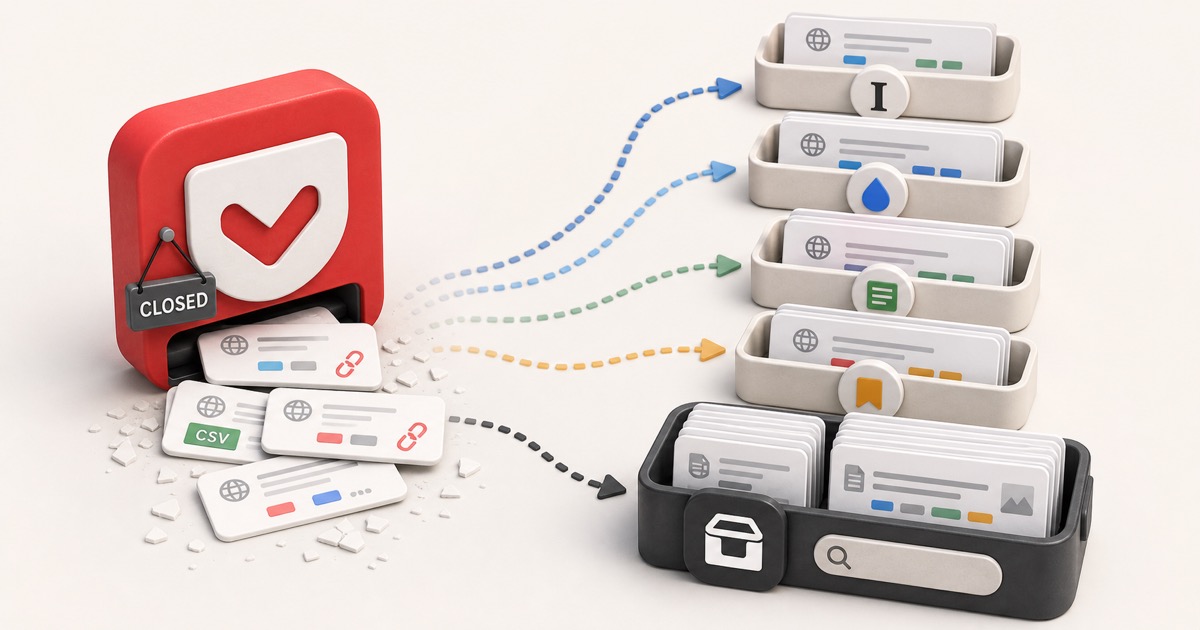
Pocket shut down in 2025: Mozilla took it read-only on July 8 and permanently deleted all user data after the November 12, 2025 export deadline. Omnivore, a popular open-source pick, was acqui-hired by ElevenLabs in late 2024; its hosted service shut down that November and deleted user data (the code lives on as self-host-only). If a 2024-era listicle still recommends either, skip it. Here's the full story on what happened to Pocket and how to move your saves.
The best read-it-later apps, compared
Here's the at-a-glance version, then the detail on each. Prices are current as of June 2026.
| App | Starting price | Free tier | Self-host |
|---|---|---|---|
| Instapaper | $5.99/mo Premium | Yes | No |
| Readwise Reader | $9.99/mo (annual) | No | No |
| Raindrop.io | ~$3/mo Pro | Yes | No |
| Matter | $8/mo Premium | Yes | No |
| Cubox | $39/yr Pro | No | No |
| GoodLinks | $9.99 once | No | No |
| Karakeep | Free (self-host) | Yes | Yes |
| Wallabag | Free / €11/yr hosted | Yes | Yes |
Instapaper: the best free reader
Instapaper is the closest thing to old Pocket: a distraction-free reading view, a genuinely usable free tier, and apps on iOS, Android, and the web. It launched in 2008, passed through Betaworks and Pinterest, and has been independently owned by Instant Paper, Inc. since 2018, surviving every handoff. That track record matters when you're trusting a service with years of saves. The free tier covers unlimited saves and sync; Premium ($5.99/month or $59.99/year) adds full-text search, unlimited notes, a PDF reader, and Send to Kindle. For most people the free version is enough. If you mostly want to read articles in peace, start here.
See how Instapaper compares to Stashr.
Readwise Reader: the power-user pick
Readwise Reader is the most capable app on this list. It pulls articles, RSS feeds, email newsletters, PDFs, EPUBs, and even YouTube transcripts into a single triaged inbox, with excellent highlighting that syncs into the broader Readwise review system. There's no permanent free tier (just a 30-day trial); it runs $9.99/month billed annually, or $12.99 month to month. It's aimed at people who read and annotate seriously. If your saved articles are research you actually work with, this is the one.
See how Readwise Reader compares to Stashr.
Raindrop.io: best when you save more than articles
Raindrop.io is a visual bookmark manager that doubles as a read-it-later app. It's the right pick if your saves are a mix of articles, videos, design references, and links rather than pure reading. The free tier is strong (unlimited bookmarks and devices), it keeps your tags, and Pro (around $3 a month billed yearly) adds full-text search, permanent cached copies of saved pages, and AI-suggested tags. If "read later" really means "keep this link," Raindrop fits better than a pure reader.
See how Raindrop.io compares to Stashr.
Matter: best for listening
Matter is a polished reader built around text-to-speech, so you can have your queue read aloud on a walk or commute. It has a clean feed, good highlighting, and a free tier; Premium ($8/month or $60/year) unlocks HD text-to-speech, unlimited highlights, and full-text search. The catch is platforms: it's iPhone, iPad, and web only, with no Android app. If you get through more of your queue by listening than by reading, Matter is worth a look.
See how Matter compares to Stashr.
Cubox: best cross-platform option with AI
Cubox is a newer cross-platform read-it-later app with a web clipper and built-in AI for tagging and summarizing. Unlike most of this list, it runs everywhere: iOS, Android, Mac, Windows, and web. There's no free tier worth relying on (Pro is around $39/year, and a Pro+AI plan around $69/year adds the AI features). If you switch between an Android phone and a Windows or Mac desktop and want one reader across all of them, Cubox is the rare option that covers the whole spread.
GoodLinks: best with no subscription
GoodLinks is the anti-subscription pick for Apple users. It's a one-time $9.99 purchase, works fully offline, stores everything locally, syncs through your own iCloud, and doesn't require an account. No monthly fee, no server holding your data hostage. The catch is it's iPhone, iPad, and Mac only. If you live in the Apple ecosystem and resent another subscription, this is the one.
Karakeep: best self-hosted option with AI tagging
Karakeep (formerly Hoarder) is the fast-rising self-hosted pick. It saves links, notes, images, and PDFs, then uses AI to auto-tag everything and runs full-text search across it all, including a real archived copy of each page. It's open-source and free to self-host, with a managed cloud plan in beta if you don't want to run a server. It's aimed at the self-hosting crowd, but it's the closest thing on this list to "capture and auto-organize everything," which is exactly the direction the category is heading.
See how Karakeep compares to Stashr.
Wallabag: best for control
Wallabag is the original open-source, self-hostable option. You can run it on your own server so no company can ever shut it down or delete your library, and there's a low-cost hosted plan (wallabag.it, about €11/year) if you don't want to manage a box. It caches article text, imports from Pocket and others, and is actively maintained, though on a slow release cadence. It's less polished than the commercial apps, but it's a reader where ownership isn't a question of someone else's business plan.
The flaw most read-it-later apps share
Here's the part worth sitting with. Pick a typical app above. Save an article. What did you actually save?
A link. A pointer that says "the thing I want is over there, on someone else's server." The app fetched a clean copy to show you, but the save itself is still tied to the original URL. That means two failure modes you can't escape by switching apps:
- The article dies. It gets deleted, paywalled, moved, or the site goes down, and your "saved" item turns into a dead link. This is link rot, and it hits a meaningful share of saved links within a few years.
- The app dies. Pocket lasted 18 years under Mozilla and still shut down and deleted everyone's data. Omnivore did the same. A hosted read-it-later service is a silo on someone else's timeline, and when the plan changes you get a few months and an export button.
An export is usually just a pile of links
When most of these apps let you "export your data," you get URLs, titles, tags, and read-status, not the article text. So even a perfect export keeps decaying: every link that 404s is a save you can no longer read, no matter which app you import it into.
A few apps do better. Wallabag and Karakeep keep an actual archived copy of each page, and Raindrop's Pro tier caches permanent copies too. That's the right instinct. But it comes with strings: the durable options are either self-hosted (you run the server), a paid add-on, or limited to web articles. None of them capture the saves you make inside the apps where you actually save most things, the bookmark on X, the saved Reddit thread, the Instagram post, the TikTok video.
The fix: capture the content, not the link
The durable version of "save it for later" is to keep a real copy of the post, article, or video the moment you stash it, in a library you control. Because it's an actual copy, not a reference:
- It survives the original being deleted, paywalled, or the host shutting down.
- It survives the app you saved it in shutting down.
- It lives in one searchable place instead of scattered across reading apps.
That's the idea behind Stashr. Its browser extension watches the platforms you already save on (X, Reddit, Instagram, TikTok, and more) and mirrors the full post into your own private, searchable library the instant you tap save, auto-tagged so you can find it in plain English later:
Stashr starts with social saves rather than web articles, so it isn't a drop-in Instapaper replacement today. But the model is the opposite of a typical read-it-later app: a real copy you own, captured automatically across the platforms you already use, not a pointer that rots. Support for saving articles, whole web pages, images, and text snippets is on the roadmap, and the core promise doesn't change as it grows.
Cleaning up a messy reading queue first?
If you're consolidating saves from Pocket plus a tangle of browser bookmarks, start with our free, no-signup tools: convert a bookmarks file to CSV, JSON, or Markdown, find and remove duplicates, and check which saved links are already dead.
Common questions
What's the best free read-it-later app in 2026?
For pure reading, Instapaper has the strongest free tier and apps on iOS, Android, and the web. If you save more than just articles, Raindrop.io has the best free tier for mixed bookmarks. If you want something no company can shut down, self-hosted Wallabag and Karakeep are free and open-source.
What replaced Pocket?
There's no single official replacement; Mozilla just shut it down. The closest in feel is Instapaper, while Readwise Reader is the upgrade for power users and Wallabag is the option you fully control. See our full guide on moving off Pocket.
Is Readwise Reader worth it over the free options?
If you highlight and review what you read, or you want RSS, newsletters, and PDFs in one inbox, yes. If you just want a clean queue of articles to read, a free reader like Instapaper covers it.
Is Matter still around in 2026?
Yes. Matter is still active and still built around its text-to-speech reading experience, on iPhone, iPad, and web (there's no Android app). It's a freemium app with Premium at $8/month or $60/year.
Will any of these keep my articles forever?
Only the ones that store a real copy, and only within limits. Most read-it-later apps save a link, so your library is only as durable as the original pages and the app itself. Self-hosted readers like Wallabag and Karakeep keep an archived copy, but you have to run them, and none of these capture the saves you make inside social apps. To actually keep everything you stash, you need a tool that saves a real copy of the content, not a reference to where it used to live. For more on why platform saves keep vanishing, see where your saved posts actually go.
Which app should I pick?
Want the best free reader: Instapaper. Power user who highlights everything: Readwise Reader. Save more than articles: Raindrop.io. Listen more than you read: Matter. One reader across Android, Windows, and Mac: Cubox. Never want a subscription and live on Apple: GoodLinks. Self-host with AI tagging: Karakeep. Own your data outright: Wallabag. And whichever you choose, keep a real copy of anything you can't afford to lose.
Stop saving links that rot. Start keeping real copies.
Stashr captures every save across every platform as a full, auto-tagged copy you own and can actually search, so the next app shutdown can't take your library with it.
14-day free trial · No credit card required · Cancel anytime