Shared document links expire. Here's how to keep the deck or PDF someone sent you.
DocSend, Drive, Dropbox, and WeTransfer links can expire, get revoked, or go dark after a deal closes. Here's why shared document links die and how to keep a copy of what you were sent.
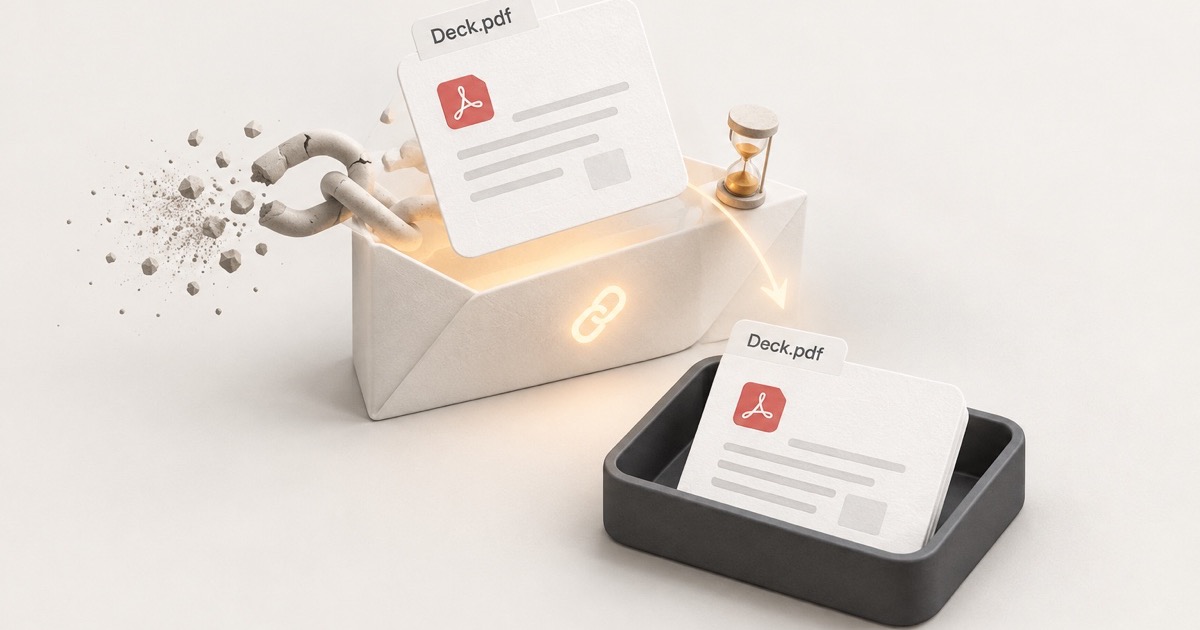
Someone sent you a deck, a contract, a report, or a PDF you'll want again. You opened it, skimmed it, and moved on, because the link was right there in your inbox. Three months later you click it and get "This link has expired," "You need access," or a login wall you can't get past. The email is fine. The document is gone.
That's not a glitch. Shared document links are built to expire. The sender can set a deadline, require your email, block downloads, or pull the link the day the deal closes, and most of the time you'll never be told. This guide covers why those links die, what to do the moment one lands in your inbox, and how to keep a copy you control. There's a short section at the end if you're the one doing the sending.
The quick answer
If a document link just arrived and you know you'll want it later:
- Open it now, not later. Every day you wait is a day closer to the expiry the sender may have set.
- Download the file if the viewer lets you. A copy on your disk can't be revoked. A link can.
- If downloads are turned off, ask for a copy. The sender chose that setting for a reason, so respect it and just ask. Most people say yes.
- Save the context with it. Who sent it, when, why, and your notes. The file alone is not enough to find it in a year.
- Put it somewhere searchable, not a Downloads folder full of
deck (3).pdf.
The rest of this guide explains what each of those steps is protecting you from.
Why a shared document link is a bookmark with a timer
A normal bookmark points at a page on someone else's server, and it dies when that page does. That's ordinary link rot, and it's slow and accidental. A shared document link is worse, because it's designed to stop working. The whole point of sending a deck through a sharing tool instead of as an attachment is that the sender keeps control after you've received it.
Here's what the popular tools let a sender do, per their own help docs:
- DocSend lets the sender set an expiration date on a link, require you to verify your email before viewing, add a passcode, and turn downloading on or off. Links can be updated or shut off after they're sent.
- Google Drive lets an owner remove anyone's access at any time. Work and school accounts can also set an expiration date on a person's access and stop viewers from downloading, printing, or copying a file. Those two controls aren't available on personal Gmail accounts.
- Dropbox lets senders on its paid plans (Professional, Essentials, Standard, Advanced, Business, Business Plus, and Enterprise) set a link expiration date, add a password, and disable downloads. Any link can be disabled after sharing.
- WeTransfer keeps transfers on its Free and Starter plans online for up to 3 days. Only the Ultimate subscription lets a sender keep a transfer active for as long as they'd like.
None of these are hidden features. They're the headline features. If you received a pitch deck through DocSend, the founder is probably watching which pages you read, and they can close the door the moment the round is done.
The link looks alive until you click it
An expired share link gives no warning in your inbox. The email sits there looking exactly as it did the day it arrived, right up until you tap it and learn the document went dark weeks ago. You only find out when you need it.
How shared links die
Five ways it happens, roughly in order of how often:
- The expiration date passes. The sender set it when they shared, and nothing reminds you.
- The sender revokes it. The deal closed, the candidate got hired, the vendor lost the contract. Access gets cleaned up and you're part of the cleanup.
- The file gets replaced. Sharing tools let the sender swap the document behind a link. The version you read may no longer be the version the link shows, with no history for you to check.
- The sender's account changes. They leave the company, their workspace gets deprovisioned, or they downgrade. WeTransfer, for example, deletes all active transfers 28 days after a paid subscription is canceled.
- The gate tightens. Email verification or a passcode gets turned on after you first opened it, and now your old browser session doesn't get you in.
None of these require you to have done anything wrong. The document had a lifespan, and it was always shorter than you assumed.
How to keep a copy of what you were sent
1. Download it while the link is live
If the viewer shows a download button, use it, today. A file on your disk is the only version of the document that can't be expired or revoked from the other end. This is the whole game, and everything below is a fallback for when it isn't allowed.
- Best for: any document you have permission to download.
- Watch out: the download is a snapshot. If the sender updates the file behind the link later, your copy won't change. That's usually what you want, but note the date you saved it.
2. If downloads are off, ask
DocSend, Drive, and Dropbox can all block downloading. When that's the case, the sender made a choice, and you'll find no shortage of blog posts explaining how to get around it. Don't. A pitch deck, a contract, or a salary band shared with downloads disabled is confidential by design, and the workaround is a bad look at best and a legal problem at worst.
Instead, reply to the email and ask for a PDF. Say why you want it ("I'd like to keep this on file" is enough). If they say no, the answer is no, and your notes from step 4 are what you keep.
- Best for: anything shared through a gated viewer.
- Watch out: a reply-and-wait takes a day. Send the ask the moment you decide the document matters, not the day the link dies.
3. Print to PDF from a normal viewer
For a Drive or Dropbox preview that lets you view but hides the download button,
the browser's print dialog (Ctrl+P / Cmd+P) with Save as PDF often works
and gives you one flat, portable file. It won't work on viewers that render pages
as images and disable printing, and again, if the sender has locked the file
down, go back to step 2.
- Best for: plain documents in a normal web preview.
- Watch out: long documents can paginate badly, and you lose any interactive bits. Check the PDF before you assume it's complete.
4. Save the context, not just the file
A year from now, you won't remember the filename. You'll remember "that deck from the fintech founder in the spring" or "the contractor rates PDF from the Hamburg agency." The file alone can't answer either search. The context can:
- Who sent it, and from which company
- When, and in what conversation
- What it was about, in your own words
- The original link, even if it's dead, so you can ask for a fresh one
The simplest version is to keep the email. The better version is to put the file and the context in one searchable place, which brings us to the last step.
5. Put it where you'll actually find it
Most people's Downloads folder is a graveyard of deck-final-v2 (1).pdf. The fix
is one library where the file, the source, and your note live together and are
searchable by meaning, not by filename.
That's the same problem Stashr solves for the posts you save every day. Its extension keeps a full copy of what you save on X, Reddit, Instagram, and TikTok the instant you save it, and you can right-click any page to clip the page, an image, or a selection into the same library. Every save is AI-tagged on the way in and findable in plain English:
stashr.search("the pitch deck from the fintech founder in spring");
// → returns your clip, with the sender, the date, and your note
For a shared deck, that means clipping the sharing page (or the email) with a sentence of context, so the record survives even after the link doesn't. Stashr isn't a PDF vault, so the downloaded file itself still lives in your cloud storage. The clip is what makes it findable.
Check the links you already have
If you've got a folder of old share links from past deals and hires, a dead link checker will tell you which ones still open, so you can ask for copies of the rest before the senders forget you.
Which links can be pulled out from under you?
| How it was shared | Can expire | Sender can revoke | Downloads can be blocked |
|---|---|---|---|
| DocSend link | Yes | Yes | Yes |
| Google Drive share | Work/school accounts | Yes | Work/school accounts |
| Dropbox link | Paid plans | Yes | Paid plans |
| WeTransfer | 3 days on free | Yes, via expiry | No |
| Email attachment | No | No | No |
Read the last row. An attachment is the only one that's yours the moment it arrives. Everything above it is a pointer to a file that someone else can turn off. If you can choose, ask for the attachment.
Features and limits move
Everything above is current at the time of writing and checked against each vendor's own help center. Sharing tools reprice, rename tiers, and shuffle features often, so confirm the details for whichever tool you're dealing with.
If you're the one sending
Everything above is the recipient's side. If you're the one sharing decks and contracts, expiring links are the right tool, not the villain. You want to know who opened what, pull access when a process ends, and keep a confidential file from being forwarded to the whole industry. DocSend made that category, but it's no longer the only option, and it isn't the cheapest.
The best DocSend alternatives for sharing decks and deal files
- SendNow: a modern, secure DocSend alternative built for founders and teams sharing pitch decks, fundraising documents, and deal-room files. Page-by-page analytics and email verification on every plan, with NDA gating, link expiry and revocation, and watermarks from Pro up. Flat pricing rather than per-seat: Lite is $9 a month ($6.25 billed annually), Pro $17 ($9 annually), and Business $43 ($20 annually).
- Papermark: open source and self-hostable, with a free plan that covers 50 documents and page-by-page analytics. Paid plans run from €29 a month (€24 billed annually), and data rooms start on the Business tier at €79. The pick if you want to own the stack or start at zero.
- PandaDoc: e-signature first, document tracking second. Right if the deck is really a proposal or contract that needs a signature at the end. Per-seat pricing, with paid plans starting around $19 per user per month billed annually at the time of writing.
Two habits make life easier for the people on the other end, whichever tool you use:
- Tell them the link's lifespan. One line in the email ("this link works until the 30th") saves a "can you resend?" thread later.
- Decide up front whether they can keep it. If the answer is yes, turn downloads on. If it's no, say so, and they'll take notes instead of asking a week after you've moved on.
Common questions
Why did my DocSend link expire?
The sender set an expiration date, turned the link off, or changed its settings to require email verification or a passcode. DocSend gives senders all of those controls, and they can change them after the link has been sent. The only fix is to ask the sender for a fresh link or a copy of the file.
Can I download a document from DocSend?
Only if the sender turned downloading on. When a download button is shown, use it. When it isn't, the sender chose to block downloads, and the right move is to ask them for a copy rather than working around the viewer.
How long does a WeTransfer link last?
On WeTransfer's Free and Starter plans, transfers stay online for up to 3 days. Senders on the Ultimate subscription can keep a transfer active as long as they like, and can change a transfer's expiry date from their account.
Can a Google Drive link expire?
Yes. Any owner can remove your access at any time, and owners with work or school accounts can set an expiration date on your access when they share. Personal Gmail accounts can't set expiration dates, but they can still remove access.
What's the safest way to keep a document someone shared with me?
Download it while the link works and save it with its context: who sent it, when, and what it was about. If the sender blocked downloads, ask for a copy. A file on your own disk with a note attached is the only version that can't be revoked.
The things you save shouldn't depend on someone else's link.
Stashr keeps a full copy of every post you save, plus any page, image, or selection you clip, the moment you save it. AI-tagged, findable in plain English, and still there when the original isn't.
7-day free trial · No credit card required · Cancel anytime